
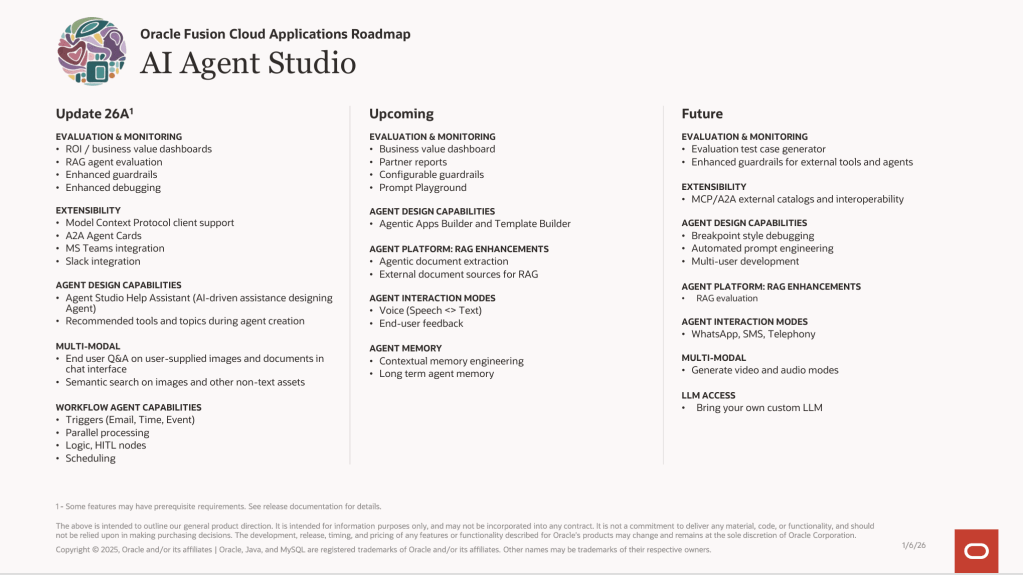
Sharing the Oracle AI Agent Studio roadmap & offering my personal perspective on what it seems to be signalling as we look ahead.
This is just how I’m reading it, and I’m eagerly looking forward to seeing how Oracle brings this to life.
What’s clear to me is this: This is not a feature roadmap.
It points to a structural shift in how Oracle enterprise applications may work in the future. It’s about rewiring how enterprise systems think, decide, and act.
𝗢𝗿𝗮𝗰𝗹𝗲 𝗶𝘀 𝗶𝗻𝗱𝘂𝘀𝘁𝗿𝗶𝗮𝗹𝗶𝘀𝗶𝗻𝗴 𝗔𝗜
Evaluation, monitoring, guardrails, debugging, and ROI dashboards – Oracle is making AI operationally safe before making it powerful.
Enterprise applications cannot afford unpredictable intelligence. This foundation tells me AI agents are expected to run core business processes, not just assist users.
“𝗨𝗽𝗰𝗼𝗺𝗶𝗻𝗴” 𝗽𝗵𝗮𝘀𝗲 – 𝗵𝗼𝘄 𝗽𝗶𝗹𝗼𝘁𝘀 𝗯𝗲𝗰𝗼𝗺𝗲 𝗽𝗹𝗮𝘁𝗳𝗼𝗿𝗺𝘀
Builders, templates, memory, external knowledge, voice, and feedback loops – AI is being standardised, not treated as bespoke experiments:
– Agentic app builders and templates make intelligence repeatable
– Contextual and long-term memory turn agents from transactional to continuous
– Voice and feedback loops show Oracle is designing for real adoption
This is where AI stops being “interesting” and starts becoming enterprise infrastructure.
𝗧𝗵𝗲 𝗳𝘂𝘁𝘂𝗿𝗲 𝗿𝗼𝗮𝗱𝗺𝗮𝗽
Evaluation test generation, RAG evaluation, breakpoint debugging, automated prompt engineering, and multi-user development – they are engineering controls.
– AI agents in ERP will soon be governed like software releases: tested, versioned, reviewed, and certified.
This is how AI becomes scalable across thousands of customers & millions of users.
𝗜𝗻𝘁𝗲𝗿𝗼𝗽𝗲𝗿𝗮𝗯𝗶𝗹𝗶𝘁𝘆 – 𝗾𝘂𝗶𝗲𝘁 𝗯𝘂𝘁 𝗽𝗼𝘄𝗲𝗿𝗳𝘂𝗹 𝘀𝗶𝗴𝗻𝗮𝗹
MCP & A2A catalogs suggests Oracle is preparing for a multi-agent world, not a closed platform.
ERP will no longer be the only system making decisions. It will coordinate with other agents, tools, and ecosystems while enforcing policy and guardrails. From this lens, enterprise applications start to look less like static systems of record and more like orchestration layers.
𝗕𝗿𝗶𝗻𝗴 𝗬𝗼𝘂𝗿 𝗢𝘄𝗻 𝗟𝗟𝗠
This tells me Oracle understands what enterprises want next:
– sovereignty
– regulation alignment
– cost control
– domain optimisation
𝗠𝘆 𝘁𝗮𝗸𝗲𝗮𝘄𝗮𝘆
This is just my perspective but reading the roadmap end-to-end, it feels like enterprise applications are evolving:
from systems that store data and report history
to systems that continuously decide, prioritise, and act.
Platforms that treat AI as an operating layer will define the next generation of enterprise systems. Oracle’s roadmap shows they are building for that reality. That’s the shift I see.
Let’s connect
Archives
- Career Talk (7)
- Journey Journal (12)
- My Oracle Journey (8)
- Reading Corner (3)
- Leadership (46)
- Oracle (63)


 Lead with Mohana
Leave a comment