
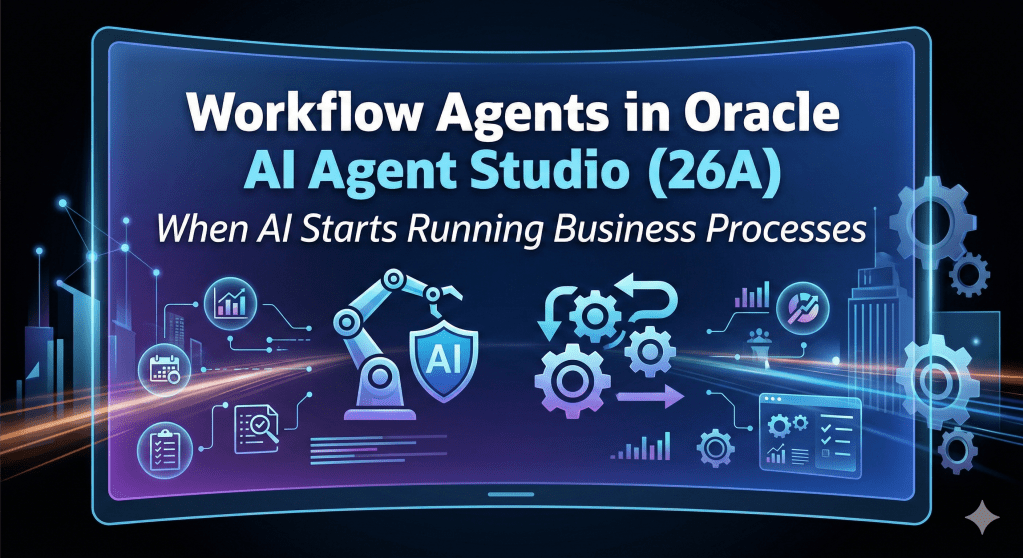
𝗪𝗼𝗿𝗸𝗳𝗹𝗼𝘄 𝗔𝗴𝗲𝗻𝘁𝘀 𝗶𝗻 𝗢𝗿𝗮𝗰𝗹𝗲 𝗔𝗜 𝗔𝗴𝗲𝗻𝘁 𝗦𝘁𝘂𝗱𝗶𝗼 (𝟮𝟲𝗔)
𝘞𝘩𝘦𝘯 𝘈𝘐 𝘚𝘵𝘢𝘳𝘵𝘴 𝘙𝘶𝘯𝘯𝘪𝘯𝘨 𝘉𝘶𝘴𝘪𝘯𝘦𝘴𝘴 𝘗𝘳𝘰𝘤𝘦𝘴𝘴𝘦𝘴
Enterprise workflows power core processes like procure-to-pay, hire-to-retire, and order-to-cash. But traditional workflows assume the world will follow a perfect predefined path.
In reality:
• Documents arrive in unexpected formats
• Emails contain incomplete information
• Exceptions appear that were never anticipated
• Humans step in to resolve issues
Traditional workflows follow fixed sequences. When something unexpected happens, they stop and wait for human intervention.
This is where Workflow Agents make a difference.
In Oracle AI Agent Studio (26A), Workflow Agents are agentic AI systems designed to execute end-to-end business workflows. They combine two capabilities that historically felt difficult to bring together:
🔹 Deterministic control flow – Governance, predictability, and auditability.
🔹 Autonomous intelligence – AI reasoning, contextual understanding, and coordination.
Think of a Workflow Agent as a process that can interpret documents, extract entities, validate information, make contextual decisions, collaborate with other agents, and loop in humans when confidence is low.
𝗛𝗼𝘄 𝗪𝗼𝗿𝗸𝗳𝗹𝗼𝘄 𝗔𝗴𝗲𝗻𝘁𝘀 𝗔𝗿𝗲 𝗗𝗲𝘀𝗶𝗴𝗻𝗲𝗱
✔Chaining – sequential processing where context flows between steps
✔Parallel – multiple branches run simultaneously and combine results
✔Switch – context-aware routing based on intent, policy, or state
✔Iteration / Looping – refine outputs until constraints are satisfied
This enables workflows to retry, correct errors, and self-heal instead of failing.
𝗛𝗼𝘄 𝗪𝗼𝗿𝗸𝗳𝗹𝗼𝘄 𝗔𝗴𝗲𝗻𝘁𝘀 𝗔𝗿𝗲 𝗧𝗿𝗶𝗴𝗴𝗲𝗿𝗲𝗱
⚡ Webhook Trigger: REST API calls from external systems initiate workflows.
📧 Email Trigger: Incoming emails (including attachments) automatically trigger workflows.
⏱ Schedule Trigger: Workflows run on interval-based or calendar-based schedules.
𝗘𝗿𝗿𝗼𝗿 𝗛𝗮𝗻𝗱𝗹𝗶𝗻𝗴 & 𝗥𝗲𝗹𝗶𝗮𝗯𝗶𝗹𝗶𝘁𝘆
Workflow Agents include enterprise-grade reliability mechanisms.
• Workflow variables to maintain state across nodes
• Node-level and global error handling
• Email notifications when failures occur
• Human-in-the-loop escalation when needed
This ensures automation remains observable, resilient, and auditable.
One example of such an agent in HCM is the Timesheet Workflow Agent. The agent can:
– Accept an uploaded signed timesheet
– Extract and validate timesheet data
– Generate the corresponding digital time card
– Save the record in the system
– Provide a summary of the results
A process that once required manual review and data entry can now be automated using AI-powered workflow orchestration.
Excited to see how organizations will use Workflow Agents in Oracle AI Agent Studio (26A) to automate complex enterprise processes.
Let’s connect
Archives
- Career Talk (7)
- Journey Journal (12)
- My Oracle Journey (8)
- Reading Corner (3)
- Leadership (46)
- Oracle (64)


 Lead with Mohana
Leave a comment