
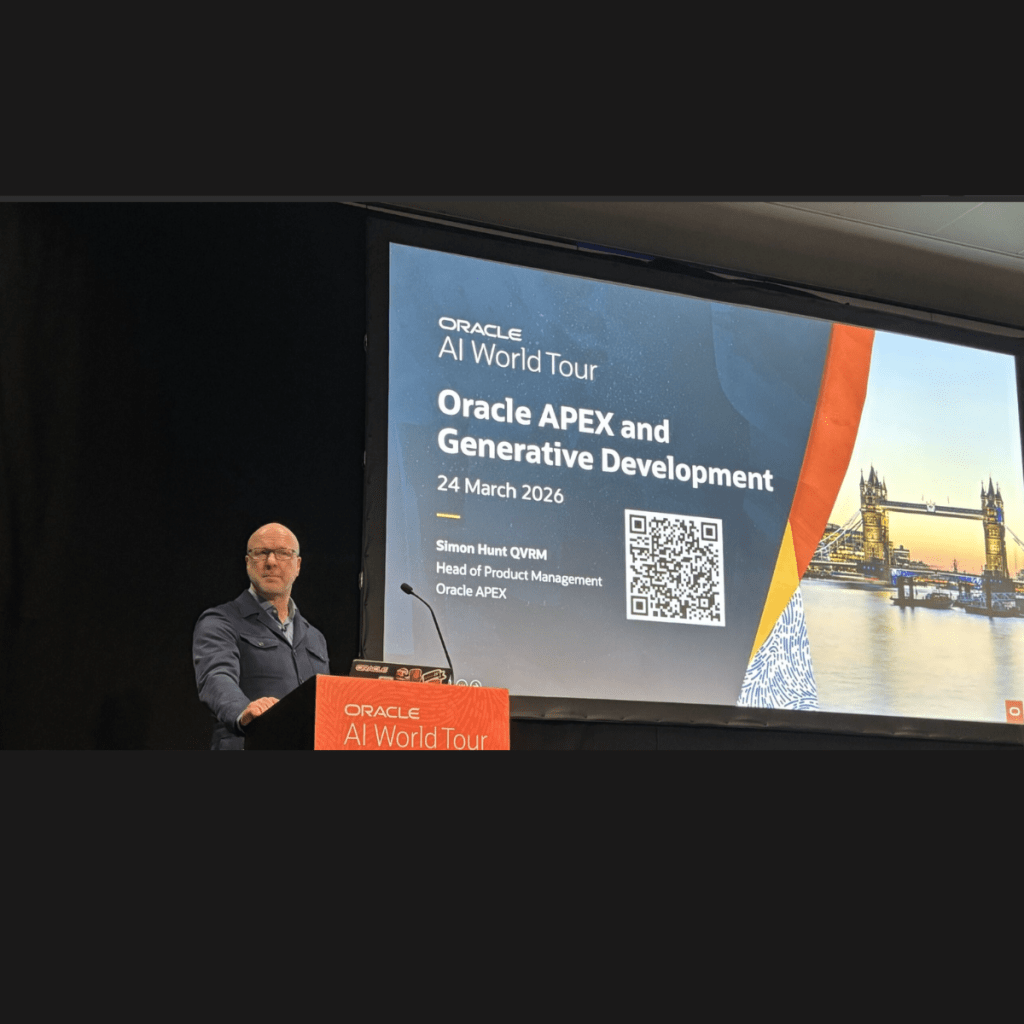
As part of my #OracleAIWorld London tour series, this blog captures key insights from the Oracle APEX session led by Simon Hunt.
𝗪𝗵𝗮𝘁 𝗶𝗳 𝗯𝘂𝗶𝗹𝗱𝗶𝗻𝗴 𝗮𝗽𝗽𝗹𝗶𝗰𝗮𝘁𝗶𝗼𝗻𝘀 𝗻𝗼 𝗹𝗼𝗻𝗴𝗲𝗿 𝘀𝘁𝗮𝗿𝘁𝗲𝗱 𝘄𝗶𝘁𝗵 𝗰𝗼𝗱𝗲, 𝗯𝘂𝘁 𝘄𝗶𝘁𝗵 𝗶𝗻𝘁𝗲𝗻𝘁?
Instead of focusing on how to build something, we express what we want and the system begins to take shape around that intent. With #OracleAPEX, this is already becoming real.
You describe your data model, and schemas are generated. Describe your application, and pages begin to form. Describe your query in plain English, and SQL is created.
A big part of enabling this shift is #APEXLang.
It is human-readable, defines applications as files, integrates naturally with version control and something AI can understand and generate.
That changes the role of development itself. Applications are no longer just written. They are interpreted, evolved, and co-created with AI.
Another key concept was 𝗦𝗽𝗲𝗰 𝘁𝗼 𝗖𝗼𝗱𝗲.
You start with requirements even a simple structured document. From there, schema definitions are generated, a blueprint is created, and that flows directly into an application.
The distance between idea and execution is shrinking and so the gap between business and engineering begins to disappear.
For smaller applications, you can move quickly from intent to application. But enterprise systems need more than speed – they need governance, structure, and repeatability.
Spec-to-code introduces that balance, ensuring AI-driven development remains controlled and reliable.
Another critical piece is 𝗰𝗼𝗻𝘁𝗲𝘅𝘁. With RAG, AI pulls directly from enterprise data – SQL queries, functions, and structured datasets. This makes responses accurate, relevant, and continuously up to date.
👉 AI moves from guessing… to knowing.
One of the most impactful demonstrations was around 𝗻𝗮𝘁𝘂𝗿𝗮𝗹 𝗹𝗮𝗻𝗴𝘂𝗮𝗴𝗲 𝗿𝗲𝗽𝗼𝗿𝘁𝗶𝗻𝗴. You simply say: “group by region and show totals” and the report updates instantly.
No menus. No SQL. No dependency.
AI understands intent, while APEX ensures structured and reliable execution.
Another important shift is how 𝗰𝗼𝗻𝘃𝗲𝗿𝘀𝗮𝘁𝗶𝗼𝗻𝗮𝗹 𝗔𝗜 embedded directly into applications. AI is no longer an add-on. It becomes part of how applications work.
At a platform level, 𝗢𝗿𝗮𝗰𝗹𝗲 𝗗𝗮𝘁𝗮𝗯𝗮𝘀𝗲 𝟮𝟲𝗔𝗜 plays a key role bringing AI into the database with vector search and annotations, enabling smarter, context-aware apps.
AI is no longer something we add – it’s being woven into how systems are built, closing the gap between business and technology.
👉 Oracle APEX is leading this shift moving development from writing code to expressing intent, from effort… to expression.
Looking forward to the release and can’t wait to start building applications in this new way.
Let’s connect
Archives
- AI (1)
- Career Talk (7)
- Journey Journal (32)
- Journey of Impact (5)
- Professional Journey (23)
- Reading Corner (3)
- Leadership (65)
- Oracle (75)
- Oracle Apex (2)
- Oracle Fusion AI Agent Studio (24)
- Oracle HCM Cloud (46)
- Oracle Knowledge Share (3)






Leave a Reply