
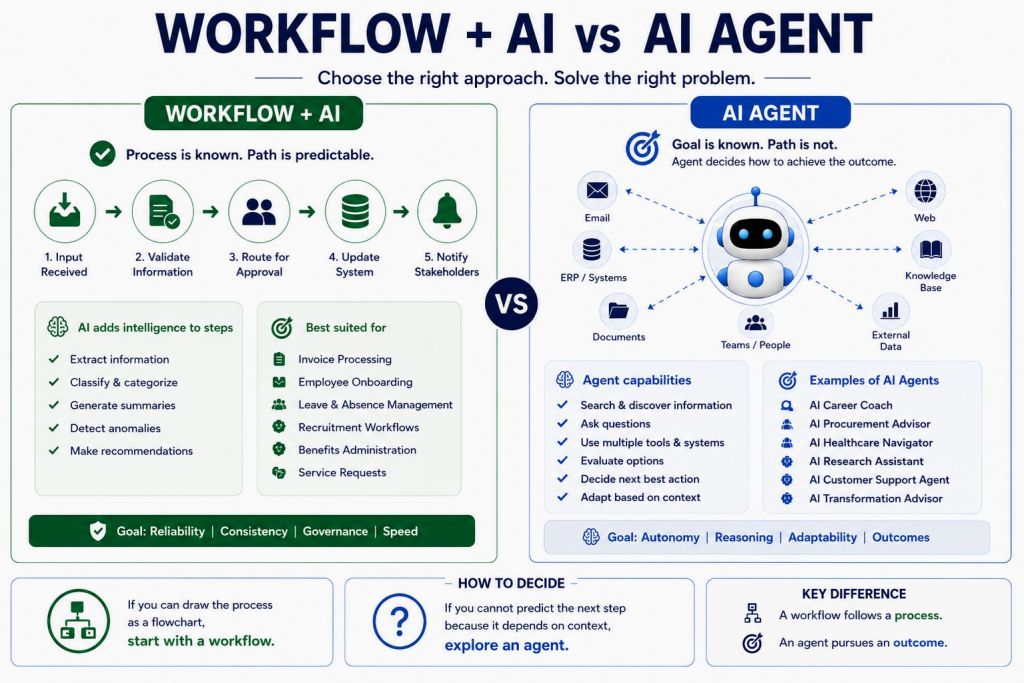
“𝗖𝗮𝗻 𝘄𝗲 𝗯𝘂𝗶𝗹𝗱 𝗮𝗻 𝗔𝗜 𝗔𝗴𝗲𝗻𝘁 𝗳𝗼𝗿 𝘁𝗵𝗶𝘀?”
Lately, that’s one of the most common questions I’m hearing.
Recently, a team approached me with an idea for an AI Agent. As we explored the requirement, I started examining how decisions were being made throughout the process.
The process was:
✅ Receive an input
✅ Validate data
✅ Route to the right person
✅ Trigger approvals
✅ Update systems
✅ Send notifications
That’s when I asked: “What decisions would the agent actually be making?”
There was a pause. Because the answer was simple: None.
Every step was already defined.
Every outcome was already known.
What they needed wasn’t necessarily an AI Agent.
What they needed was a well-designed workflow enhanced with AI.
This is something I’m seeing more frequently as organisations accelerate their AI initiatives.
Many conversations start with:
❌ “How do we build an AI Agent?”
But the better question is:
✅ “Where does intelligence genuinely add value?”
There is an important distinction.
🔹 A workflow follows a known path.
🔹 An agent determines its own path to achieve an outcome.
Agents are powerful when:
• The outcome is uncertain
• Multiple paths are possible
• Reasoning and judgement are required
• Information must be gathered from multiple sources
• The next best action is not immediately obvious
Workflows are powerful when:
• Rules are known
• Decisions are predictable
• Compliance and governance matter
• Consistency is critical
• Reliability is more important than autonomy
In many cases, AI can create tremendous value without becoming an agent.
AI can:
✔ Extract information from documents
✔ Generate summaries and insights
✔ Detect anomalies and risks
✔ Make recommendations
✔ Improve the user experience
While the workflow remains in control.
The most successful AI implementations are not the ones with the most sophisticated architecture. They are the ones that solve a real business problem in the simplest and most effective way.
Rule of thumb:
👉 If you can predict the next step, start with a workflow and add AI where it creates value.
👉 If you can’t predict the next step, explore an agent.
The future of enterprise AI isn’t about replacing every process with an agent.
It’s about knowing when to automate, when to augment, and when to let intelligence take the lead.






Leave a Reply